
The 7-Lever Workflow Audit: How to Tell If an Operational Workflow Is Actually Modern
A 0–5 scoring framework for Nordic operations leaders deciding which workflow to modernize first.
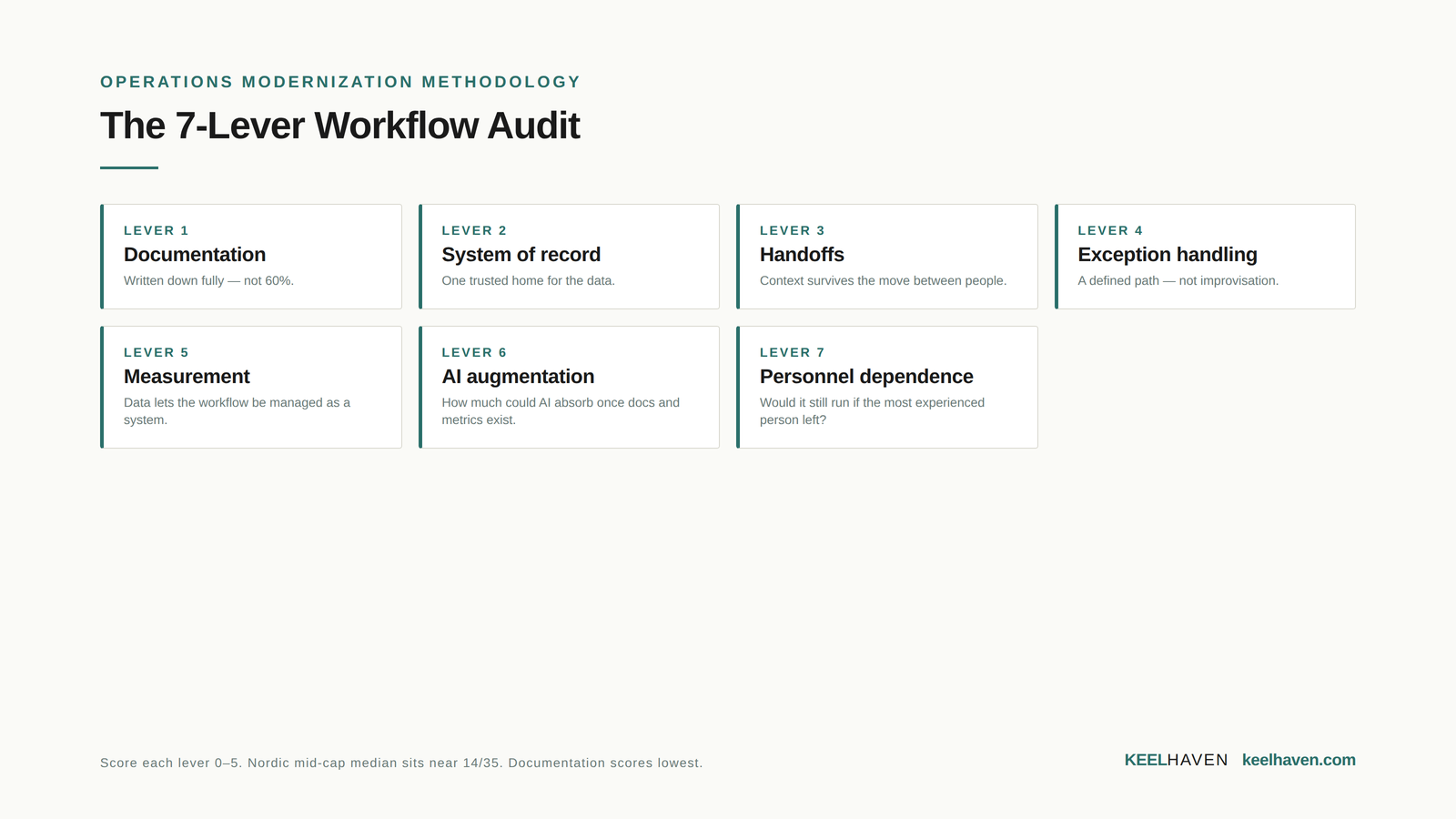
"We should modernize our operations" is a sentence almost every operations leader at a Nordic mid-cap has said, and almost none have been able to act on. The sentence is too big. It does not name a first move. It invites a transformation program, and transformation programs, in this market, have a long history of under-delivering.
The way to make the sentence actionable is to stop talking about "operations" and start talking about one workflow — and to break that single workflow into seven specific levers, each of which is either in place or not. This post is that framework. You can run it this week, on one of your own workflows, and finish with a number and a clear first move.
First, a definition, because the word "modernization" has been used loosely enough to mean almost nothing.
What modernization is, and is not
Modernization is not digitization — putting things into computers. Your mid-cap did that years ago; the Excel files are already digital. It is not automation — replacing people with software, which is a tool and not a goal. It is not transformation — a word broad enough to cover a rebrand. And it is not AI adoption — using AI tools, which is one component of modernization rather than the thing itself.
Modernization, used precisely, means replacing manual, undocumented, individual-knowledge-dependent operational work with work that is systematic, measured, and AI-augmented — work that does not depend on any single employee to keep running. It is concerned with three outcomes: reliability (consistent output regardless of who runs the workflow), measurability (the workflow produces data that lets it be managed as a system), and continuity (it no longer depends on any specific person staying at the company).
A simple test: if a change does not deliver at least two of those three, it is not modernization. It is tool adoption — useful, but not the same thing.
The seven-lever audit measures how far a given workflow is from those three outcomes.
Why one workflow, not the whole operation
Before the levers, the reason the unit of analysis is a single workflow.
Big-bang transformation programs fail in this market for a structural reason, not a quality one. They ask an entire organization to change at once, and in doing so they leave nobody operationally accountable for any single workflow — responsibility spread across everything lands nowhere. And because Nordic mid-caps are typically profitable and under no existential pressure, a program that creates friction does not get fought. It gets quietly outlasted.
Modernizing one workflow at a time avoids both failure modes. A single workflow is small enough not to trigger organizational resistance, and concrete enough that it cannot be outlasted. So the audit scores one workflow. Run it several times on several workflows and you also get something useful: a ranked list of where to start.
The seven levers
Score each lever 0–5 for the workflow you have chosen. Thirty-five points total.
Lever 1 — Documentation. Is the workflow written down — fully, not the 60% that the person running it would produce if asked? A 0 means the workflow exists only in someone's head. A 5 means a competent new hire could read the documentation and run the workflow correctly. In our experience auditing Nordic mid-cap workflows, this is the lowest-scoring lever almost every time. It is also the one everything else depends on.
Lever 2 — System of record. Does the workflow's data live in one trusted place, or is it spread across a constellation of spreadsheets, emails, and individual hard drives? A 0 means there is no single source of truth and people reconcile by hand. A 5 means one system holds the authoritative data and everyone trusts it.
Lever 3 — Handoffs. When the work moves between people or departments, does context survive the move? A 0 means handoffs are informal and lose information every time. A 5 means handoffs are structured and complete, and the receiving party never has to re-discover what the sender already knew.
Lever 4 — Exception handling. When something non-standard happens, is there a defined path — or does the outcome depend on who happens to be on shift? A 0 means every exception is improvised. A 5 means exceptions have defined handling and only genuinely novel cases escalate.
Lever 5 — Measurement. Does the workflow produce data that lets it be managed as a system rather than a folk practice? A 0 means nobody knows how long the workflow takes, how often it errs, or where it stalls. A 5 means the workflow is instrumented and its key metrics are visible and reviewed.
Lever 6 — AI augmentation potential. This lever is scored differently — it is a measure of opportunity, not current state. Once the workflow is documented and measured, how much of it could AI realistically absorb? A low score means the workflow is inherently judgment-heavy and human-bound. A high score means a significant share of the work is repetitive, rule-governed, and a strong candidate for augmentation. A high score here on a low-scoring workflow elsewhere is a strong "modernize this one first" signal.
Lever 7 — Personnel dependence. Would the workflow still run, at quality, if the most experienced person left tomorrow? A 0 means the workflow runs because one specific person knows how to run it. A 5 means the workflow is fully system-borne and no individual is load-bearing. Note that this lever tends to move on its own once levers 1–5 are addressed.
Reading the total
Score out of 35. In our experience auditing Nordic mid-cap workflows, the median lands around 14 — and the single lowest-scoring lever, almost every time, is Documentation.
A low total is not an indictment. These workflows were built by competent people and have run profitably for years. A low score means the workflow runs on individual knowledge rather than on a system — which is fine until the individual leaves, at which point it is very much not fine. The audit makes that latent risk visible before it becomes a live one.
The sequence the score implies
The seven levers are not a menu. They are a sequence, and the order matters.
Documentation comes first, because every later lever rests on it — you cannot build a system of record for a workflow you have not described. System of record comes second. Measurement third — once a workflow is documented and its data centralized, it can finally be measured. Handoffs and exception handling fourth. AI augmentation fifth — and only fifth, because AI deployed onto an undocumented, unmeasured workflow produces inconsistent results that erode trust in AI across the whole company and set the real modernization back by a year. Personnel dependence sixth, largely self-resolving once the rest is done.
The unglamorous headline: documentation before AI, almost every time. AI is the reward at the end of the sequence, not the shortcut at the start.
What to do with the audit
Run the audit on three to five of your workflows — the ones you suspect are fragile, or expensive, or both. You will get a ranked list. The best first workflow to modernize is usually the one that combines a low total score (lots of headroom), a high Lever 6 score (real AI opportunity), and a visible, costly, well-defined problem that the leadership team already recognizes.
That workflow becomes your demonstration. Modernized end to end, run in production, measured — it makes the case for the next workflow without anyone having to build a slide.
Questions
The full audit, with worked examples, is in our operations modernization playbook. To talk through your results against your own workflows: hello@keelhaven.com.